
I'm volunteering (and preparing) for my own Herxheimer reaction against Chlamydia/Chlamydophila pneumoniae
Prepping to Herx: If ya gotta get hit by a truck, then you might as well prepare yourself for it

As I mentioned recently (28Mar2026), I had expected our recent travel to alleviate me of the “allergic sinusitis” that I had been experiencing for about seven days, but when the “allergy” did not abate, that left me with two diagnostic possibilities:
I had unexpectedly traveled to a region that contained the same allergen, which I strongly suspect is eucalyptus (or a mold that grows on eucalyptus), and/or
My “allergic sinusitis” wasn’t allergic sinusitis but actually a smoldering bacterial or fungal infection.
Possibly a combination of both options: a smoldering dysbiosis that flares when exposed to a known allergen.
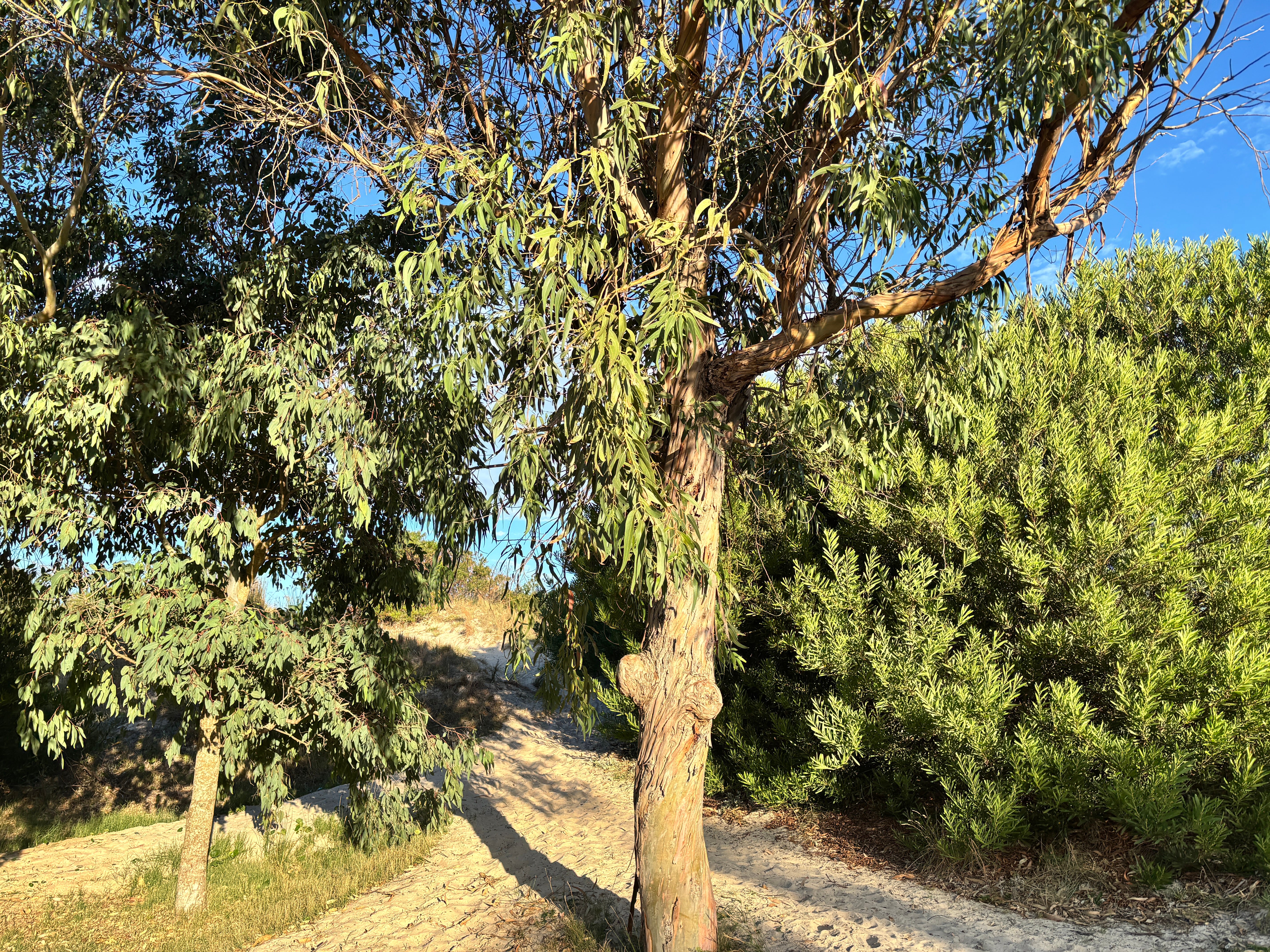
Turns out that all of the above were correct. My allergen eucalyptus occurs internationally; even though the origin of eucalyptus is Australia, the tree is now found throughout the Americas—from USA and Canada to my beloved Patagonia1 region of Chile and Argentina; my worst allergic reactions to eucalyptus occured (twice) in Spain. I was shocked on the last day of our trip as we were leaving a beach in Uruguay that I found myself face-to-face with a grand eucalyptus tree—pictured below. As such, allergic sinusitis could not be excluded, and given my history of allergy to eucalyptus, it had to be included.
Of note, I had been treating my occasional sinusitis not only with the usual meds, but also with nutrients-botanicals (which were commonly more potent than the FDA-approved drugs) as I discussed in video (15Feb2026).
“Patients are entitled to more than one disease.”
Ron LeFebvre DC, one of my chiropractic college professors c.1995
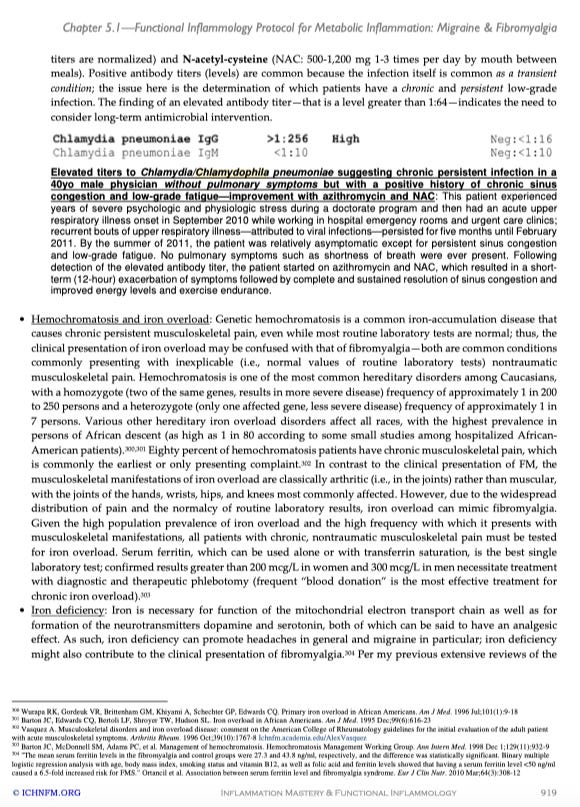
However, allergic sinusitis does not exclude dysbiotic sinusitis, and the two would be expected to be synergistic as they both promote local inflammation. On one occasion during our travels, I woke up with mild bronchitis, which I had to interpret as having a microbial origin. As noted in my book Inflammation Mastery 4th Edition, some people (including me) are chronic carriers of the intracellular bacterium Chlamydia/Chlamydophila pneumoniae. As such, I was forced to contend with this obvious clinical diagnosis. I had briefly described my previous personal case on page 919 of Inflammation Mastery 4th Edition, excerpted below.
When I had previously (2011) treated myself for subclinical Chlamydia/Chlamydophila pneumoniae using azithromycin, I had a very mild Herxheimer reaction—an inflammatory response triggered by the debris of dying bacteria. As such and in anticipation of the same, I treated myself with a low dose of azithromycin—only 250 mg in contrast to the usual starting dose of 500 mg. The effects were moderately devastating: for two days I had a horrendous and uncontrollable cough that left me feeling like I had just done back-to-back sessions of full-contact Taekwondo and Jujutsu (yes, I have trained in both); I felt like I had been run-over by the proverbial dump truck. However, I felt better thereafter—no cough, no sinus congestion, but persistent phlegm and mucorrhea—constant mucus production beyond what can be considered normal. Thus, my clinical diagnosis of sinorespiratory dysbiosis was confirmed.
Hard (but unavoidable) pill to swallow
I have done everything reasonable to address this persistent/recurrent sinusitis as if it were purely allergic—results have been generally satisfactory but also incomplete. As such and given all of the above, the only reasonable and responsible action for me to take is to take a complete course of azithromycin to eliminate (optimistically) or reduce (realistically) the microbial burden, specifically but not exclusively the Chlamydia/Chlamydophila pneumoniae. I seem to tolerate the drug quite well, but I have every reason to dread the upcoming Herxheimer/Herx reaction; but fortunately, I know how to prepare for it this time.
I’m not sick, but I am not fully and optimally well
I currently don’t have any major health problems, but my minor problems include:
Aforementioned chronic/recurrent sinus congestion, which commonly clears almost completely and when exacerbated is controlled reasonably well with nasal decongestant/steroid sprays and perhaps a little bit (eg 5mg) of oral prednisolone.
Sometimes a bit of generalized fatigue, even after sleeping and resting well. I still exercise and work every day, but these could both be a bit more vigorous.
Sure I could lose another 2kg/5lbs to 5kg/10lbs even though I am generally at about 10% body fat (quite low) and I am at my normal body weight of about 100kg or 220lbs.
Chronic carriage of Chlamydia/Chlamydophila pneumoniae carries its own problems
Chronic asymptomatic carriage of Chlamydia/Chlamydophila pneumoniae associates with a wide range of problems:
Chronic fatigue
Chronic sinusitis and bronchitis
Some autoimmune diseases—which I do not have
Acceleration of atherosclerosis—which I show no signs of
Increased risk for brain problems like stroke and dementia—as expected from any chronic inflammatory condition
Prepping to Herx: If ya gotta get hit by a truck, then you might as well prepare yourself for it
I will outline and detail my preparation for the upcoming Herx reaction in an upcoming post. Somewhat surprisingly, none of the standard medical protocols for antibiotic drug treatment even consider this important component of treatment, so everything I mention will be “new” to the topic and will eventually be included in my final update to Inflammation Mastery. Stay tuned!
Hermsen EJ, Gandolfo MA, Zamaloa Mdel C. The fossil record of Eucalyptus in Patagonia. Am J Bot. 2012 Aug;99(8):1356-74. doi: 10.3732/ajb.1200025. Epub 2012 Aug 1. PMID: 22859652. https://bsapubs.onlinelibrary.wiley.com/doi/10.3732/ajb.1200025