
SUBSCRIBER PREVIEW: Family Tree Exercise in 4 parts (2Nov2025)
This is a work in progress, but is mostly complete and reasonably represented here

Thanks for joining us – today’s health homework assignment is designed to help you to get to know yourself better and also for you to be happier, healthier, and stronger in the future. These health homework assignments from Dr. Vasquez cover a wide range of topics and activities ranging from diet and nutrition, to laboratory tests, to physical exercises, to safeguarding your financial and legal health. Since this is a work-in-progress, be sure to check the website for the most recent version and updates.
Today’s assignment has four components, and you are invited to do each of these in sequence one after the other, but not advancing to the next one before you finished the one before. If you skip to the end, then you’re probably going to miss out on the full benefits of this exercise, and you’re depriving yourself of the adventure of life and some surprises along the way. Everybody loves surprises, just like they love receiving stickers, donuts and hamburgers (especially after their experimental emergency authorized injections—just kidding on that last part!).
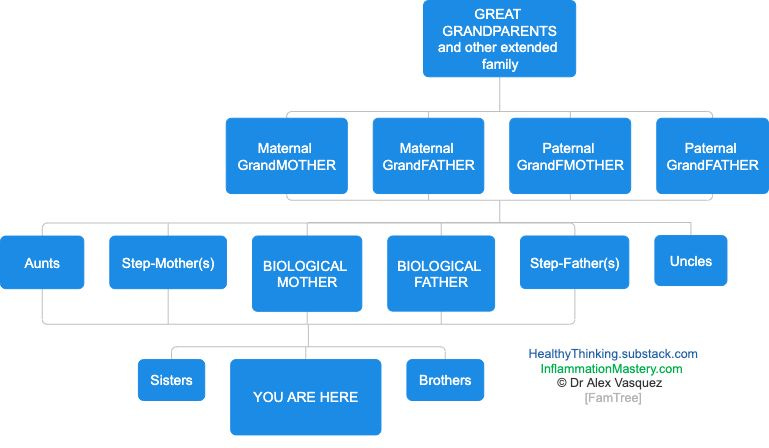
Part one – draw out your family tree. Include your brothers and sisters and mothers and fathers and aunts and uncles and grandparents.
Doesn’t matter if you have a big family or small one; good and bad families come in all shapes and sizes. Start by listing out the actual people who are your family and especially the people who helped raise you when you were a kid. Now, after you’ve listed out the people in your family, you need to list out the institutions and organizations such as schools, social groups, and churches that you were a part of in your developing years because these social structures also have the task of raising you, forming you and preparing you for the future. What churches did you attend? What schools did you go to? What other activities in organizations were you part of? This part one exercise described above is what we can call the “structure” of the actual people and organizations around you when you were growing up. Your tree should probably look something like this:
Part two – Now that you’ve outlined your family tree with names of all the people in your family, next to each one, write a short few words for the people who helped nourish you, shelter you and teach you to feel capable, secure, and optimistic.
Who provided your food and shelter?
Who helped you feel happy and secure as a child so that you could grow into a happy and secure adult?
Who protected you? Who could you rely on?
Who modelled competence in social interactions and practical skills?
Who taught you basic skills like swimming, riding a bike, sewing, and using tools?
Who provided you fun activities and bought you toys and provided you activities so that you could explore your own interests and develop talents?
This part two exercise described above is what we can call the “function“ of the people and organizations around you when you were growing up.
Thank you for supporting this archive of information for the cost of a coffee while I am working—about $4.20—for the hours, days, months and years developing this archive which now contains more than 1,000 pages and hundreds of hours of videos on a wide range of topics including Clinical Nutrition (including the Vitamin D series of Videos and Scientific Publications), Antiviral Strategies, Microbiome+Dysbiosis (CME series of >12 videos), Functional Medicine (conference videos) and Pharmacology (of Vitamin B12 and Pediatric Injections,.. Leadership, Critical Analysis of Research and Social Events, architecture, music (Celibidache), philosophy, and a few tutorial videos on fun topics like how to select a good wine/whiskey(and minimize the risks)! HealthyThinking.substack.comincludes a wide range of topics including music, politics, architecture, logic, philosophy, recipes (ie, “everything”) plus “Health Homework” (series)to inform and remind you about important health-promoting actions…whereasInflammationMastery.substack.com attempts to be more/strictly clinical and specific to book updates, clinical research and protocols. Remember that you can always find the newest articles-videos and the most popular pages here at the INDEX where you can also USE THE SEARCH FUNCTION to find exactly what you are looking for.
Part three – Now in a different color (pen, pencil, crayon, marker) next to each person in your family who helped raise you, write down exactly what they did in order to prepare you for the future.
Examples:
Who taught you how to cook some good meals so that you can take care of yourself?
Who taught you some basics about exercise, stretching, and taking care of your body?
Who taught you how to balance a checkbook and do your bookkeeping?
Who taught you how to pay your taxes appropriately?
Who taught you how to purchase investments instead of distractions?
Who taught you how to deal with manipulative people in the world?
Who taught you how to negotiate your salary?
Who taught you how to make life decisions based on probability of success rather than fantasy and other dumb ideas like “follow your bliss”?
Who taught you how to speak a second language, or who at least modelled for you that this was possible and a good idea so that you would have more flexibility in the future?
If you were neglected or abused, who was the abuser, and who were the enablers?
This part three exercise described above is what we can call the “preparation“ (or sabotage) provided by the people and organizations around you when you were growing up. Keep in mind that the same person in your life can play the role of both villain and hero at the same time: perhaps the person who fed and sheltered you (hero) was also emotionally or physically abusive (villain); the person who gave you positive encouragement might have also undercut you in other ways, etc.
This is basically an inventory of reality. And like any inventory, its quality (percieved value of the components) and contents (rememberance) may change over time. With time, we are able to tolerate and accumulate more truth, and thus the accuracy of our memory and willingness to see things as they truly are increases.
WRITING IS REALITY.
I was fortunate to have had an English teacher in my last 2 years at Riverside Military Academy who said to us, “If you really think you understand something, then challenge yourself by attempting to write it down.”
The distinction between reality and deception is a black-and-white line drawn on a piece of paper. If you think you are the owner of a specific truth, then challenge your perception by writing it down and filling in the spaces under each title and subtitle of what you pretend to know.

Part four – By this point in the exercise, you’re either feeling great and affirmed or you’re noticing that your life was at least partly wanting/empty of the love, support, nurturing, advice, and lessons that you needed in order to navigate your childhood successfully and with high probability of becoming a happy and successful adult.
This is a consciousness-raising exercise, and in the following short section I will describe its practical value.